


EPG Sustainability Topics
Sustainability Assessment Process


1. Identification Identifying sustainability issues by understanding the sustainability landscape relevant to the organization.
The companies and subsidiaries collaborated to identify key sustainability issues of the new organization, encompassing all activities throughout the value chain. Considering the company's goals and business direction, they analyzed significant trends and other external factors that could positively or negatively impact the company's operations, including the potential impacts on the economy, the environment, and people, such as global changes and regional transformations. They also assessed the world's risk trends, criteria set in industry standards, and sustainability assessment models. Key issues of companies in related industries were also gathered. Additionally, the company collected sustainability issues from stakeholders both internally and externally through various appropriate channels and methods, tailored to stakeholders' interests. The number of key issues decreased from the previous consideration of 23 to 19 due to some issues being consolidated.
| Corporate Governance and Economic |
Environment | Society |
|---|---|---|
| 1. Good Governancez | 9. Energy Efficiency | 14. Employee Engagement and retention |
| 2. Ethic and Anti-corruption | 10. Environmental Impact Management | 15. Human Resource development |
| 3. Risk Management | 11. Water Management | 16. Occupational Health and safety |
| 4. Data Security | 12. Climate Change Adaptation | 17. Product Responsibility |
| 5. Innovation and Process Development | 13. Greenhouse Gas Emission | 18. Community development |
| 6. Innovation Products and services | 19. Human Rights | |
| 7. Customer Relationship and Engagement | ||
| 8. Supply Chain Management |
2. Assessing the impact of sustainability issues on the company and stakeholders.
The company evaluates the importance and impact of sustainability issues in two levels:
- The company assesses the level of importance of sustainability issues to the organization by considering their impact on the company's business operations, financial performance, operational processes, strategies, reputation, and legal compliance.
- The company evaluates the level of impact of sustainability issues resulting from its business operations on stakeholders or the decisions of stakeholders on the company's business operations.
3. Prioritization
Following the assessment of the significance and impacts under Item (2), the Company prioritized all 19 sustainability topics using the Double Materiality principle and mapped them into a Materiality Matrix in accordance with the Global Reporting Initiative(GRI Standards) guidelines, comprising the following dimensions:
- The vertical axis (Y-axis) represents the level of impact that the Company’s business operations have on the economy, environment, and people (including stakeholders).
- The horizontal axis (X-axis) represents the level of impact that sustainability issues have on the Company’s business operations and its ability to deliver value in line with its sustainability commitments.
4. Reasoning
The 19 key materiality issues have been approved by the board of directors the Sustainability and Corporate Governance Committee the Executive Committee and the CEO (Disclosure 102-32). Among these, four strategic priorities have been identified: good governance, innovation and process development, human resource management, and adaptation to and opportunity creation from climate change. The management has been tasked with addressing both the strategic priorities and ongoing sustainability issues. However, the company has not yet defined performance indicators for operations and linked them to the performance evaluation of relevant managers and employees. This will be addressed by the company in the future.
The company mandates an annual review of key sustainability issues by the Sustainable Development Task Force and the company's board of directors to adapt them appropriately to changing external circumstances or organizational contexts. This review includes addressing issues of concern to stakeholders.
Key sustainability issues (Disclosure 102-47)
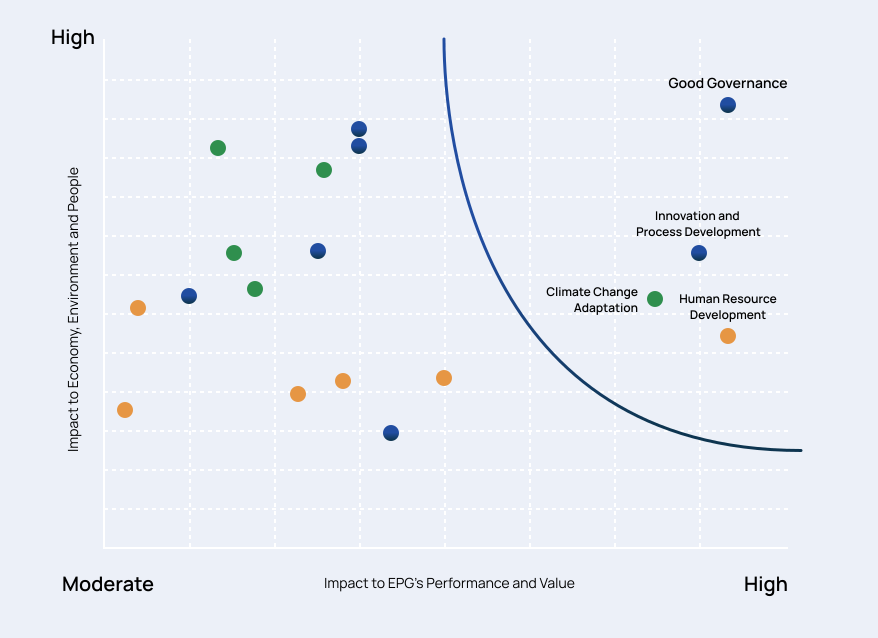
The Company has established an annual review process for material sustainability issues, conducted by the Sustainable Development Working Committee the Sustainability and Corporate Governance Committee and the Board of Directors. This review ensures that the identified issues remain relevant and appropriately reflect changes in the external environment, business context, and stakeholder expectations, while also covering emerging topics of interest to stakeholders.
The sustainability issues that are of secondary importance (vertical on the left-hand side) are part of the four key strategic sustainability issues (horizontal).
| Materiality Issue | Corporate Governance |
Innovation for sustainable growth |
People Management |
Climate resilience / Strategy |
|---|---|---|---|---|
| Ethic and Anti-corruption | ||||
| Risk Management | ||||
| Data Security | ||||
| Quality of product and services | ||||
| Customer Relationship and Engagement | ||||
| Supply Chain Management | ||||
| Human Resource development | ||||
| Occupational Health and safety | ||||
| Product Responsibility | ||||
| Community development | ||||
| Human Rights | ||||
| Energy Efficiency | ||||
| Waste Management | ||||
| Water management | ||||
| Greenhouse gas emission |